Wilderness/Austere Medical Assistant
Fireline Science founder Collin Sellman spent almost a decade as a U.S. Forest Service wildland firefighter on the Kaibab National Forest, where medical emergencies happened far from hospitals and often far from cell service. He remains active in the backcountry as a volunteer trail steward for the Phoenix Mountain Preserves and maintains his Wilderness First Responder certification—a commitment to what Theodore Roosevelt called "the strenuous life" and the preparedness it demands.
That ongoing field experience surfaced a familiar problem: life-saving skills start degrading immediately after training, and the environments where responders need them most are exactly the environments where refresher tools don't work.
Wilderness medicine, tactical care, and disaster response share a common challenge. Skills decay without deliberate practice—and responders often overestimate their own competence as that decay happens. Meanwhile, the austere settings where these skills matter most are precisely where cloud-based training tools fail: backcountry with no cell signal, forward-deployed teams training in contested regions, disaster zones where infrastructure is down. You can't maintain readiness with tools that only work when everything else is working too.
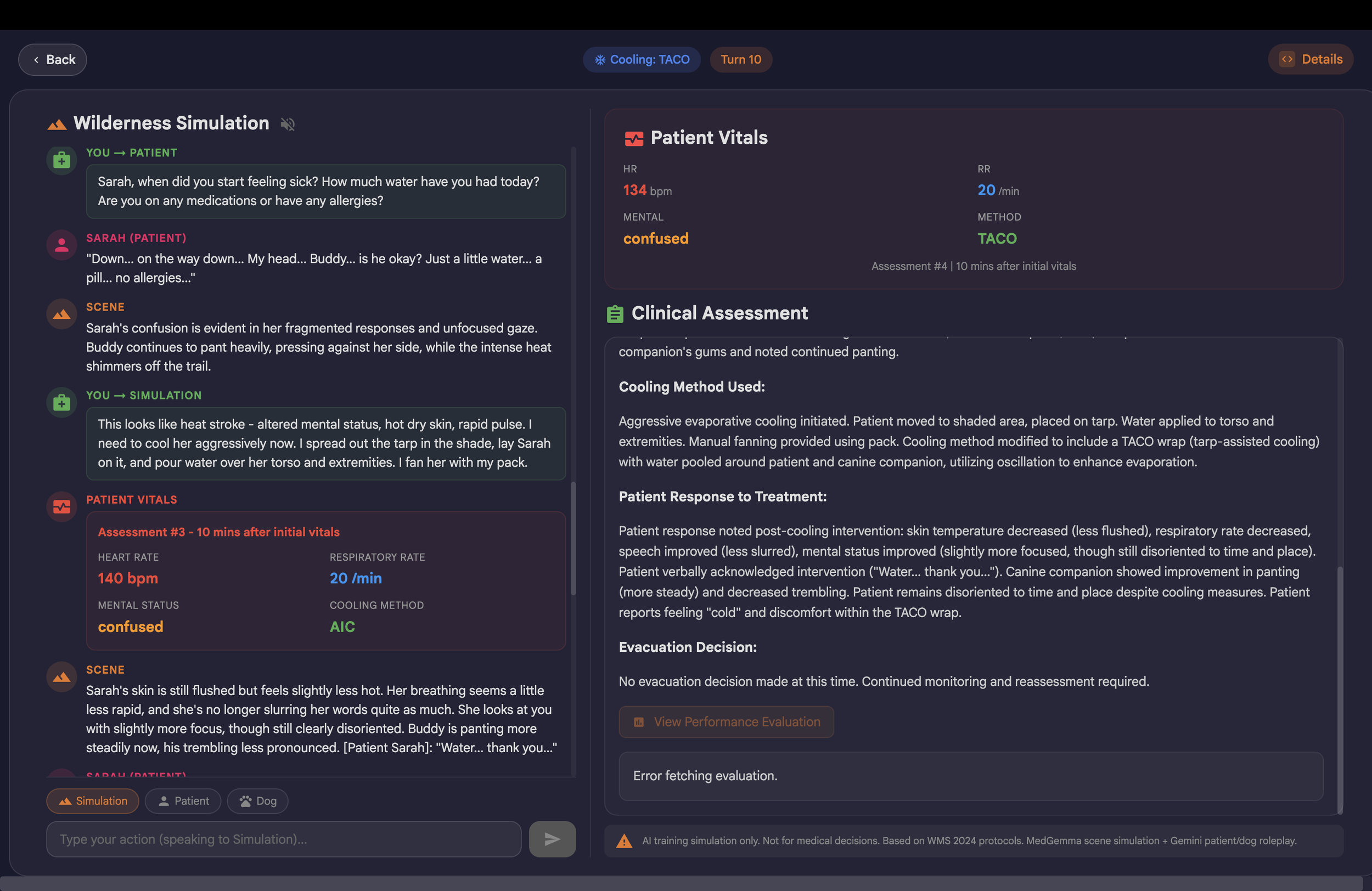
Fireline Science is building an offline AI training assistant that keeps responders sharp between certifications. The system runs entirely on local devices—no internet required after initial setup—with realistic patient physiology that responds to user decisions. True to the medical director-in-the-loop approach, development is underway in collaboration with wilderness medicine training organizations, an EMS medical director, and a trauma surgeon.
Our Unique Technical Approach
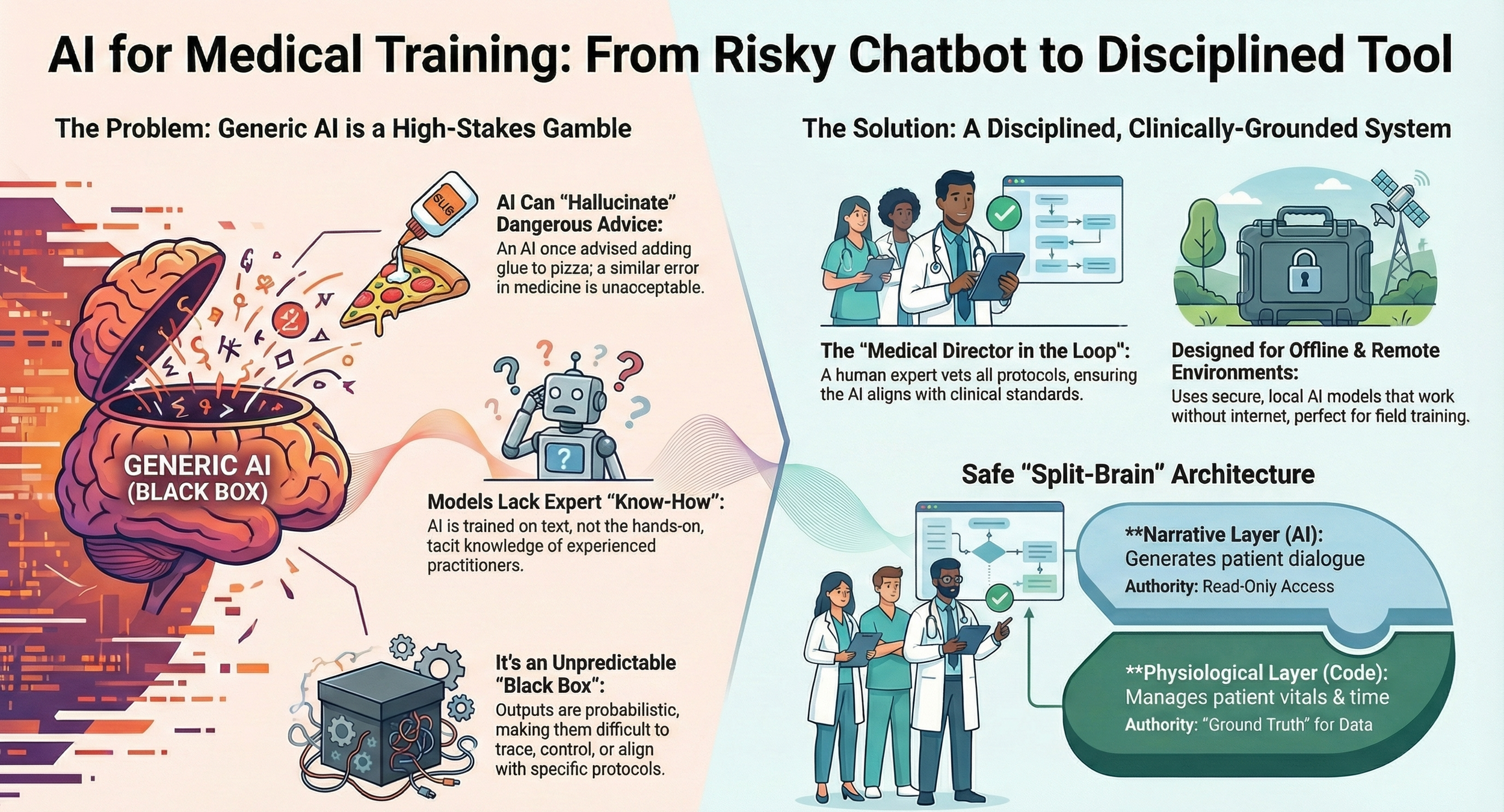
Generic AI chatbots present real risks in medical contexts: they hallucinate confident-sounding but dangerous advice, lack the experiential judgment of trained responders, and typically require constant internet connectivity. The Fireline Science approach addresses these limitations through a split-brain architecture that separates what AI does well from what it shouldn't control.
The AI handles natural language—generating realistic patient dialogue and scene descriptions. But it has read-only access to medical data. A deterministic physiological engine governs vitals and patient outcomes using validated models, enforcing clinical accuracy the AI cannot override. If a user fails to initiate cooling in a heat stroke scenario, the patient deteriorates according to the physiology—not according to what sounds narratively satisfying.
The training assistant supports both wilderness medicine protocols (the Patient Assessment System used in WFR certification) and tactical medical frameworks (TCCC's MARCH sequence: Massive hemorrhage, Airway, Respiration, Circulation, Hypothermia/Head injury). Both domains share the same fundamental challenge—skills decay between certifications, and the environments where they matter most are disconnected from cloud infrastructure.
This mirrors the teacher-in-the-loop model that guides all Fireline Science products. Just as teachers review and approve AI-assisted feedback in our educational platforms, medical directors vet simulation content against local protocols, provide feedback to students, and shape the AI models through iterative review. The AI amplifies expert judgment rather than replacing it.
Currently in pilot development. Contact us to discuss partnership opportunities for wilderness medicine programs, tactical medical training, or remote EMS operations.